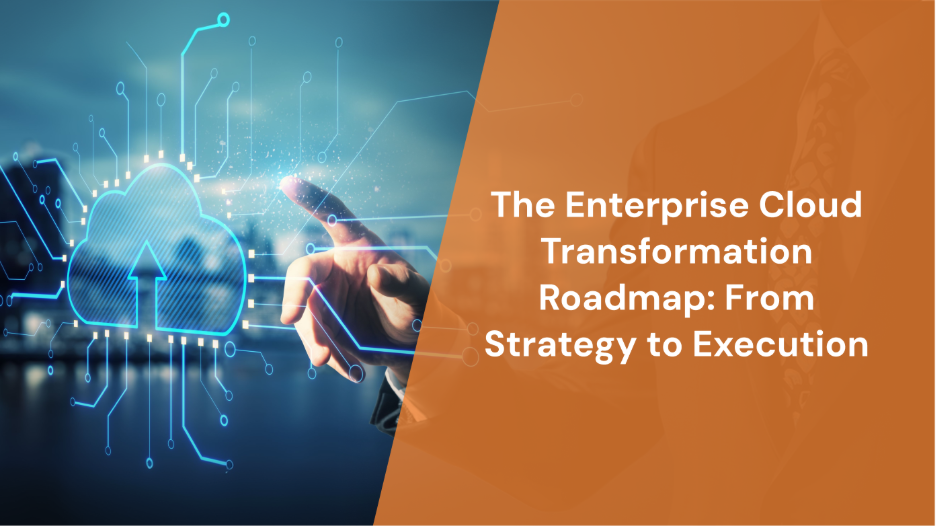
A successful cloud transformation roadmap defines how applications, infrastructure, security, governance, and engineering ownership move from strategy into execution. Without that execution plan, even well-defined cloud strategies often stall before delivering business value.
The challenge is rarely defining the destination. It is translating strategic objectives into workload-level engineering decisions that teams can execute with confidence.
This isn’t a failure of ambition. Most cloud transformation strategies are perfectly sound on paper. What breaks them is the six months between the strategy being approved and the first workload landing in a new environment, the gap where a business case turns into engineering decisions that nobody wrote down in the boardroom.
Key Takeaways
• Cloud transformation strategies often fail during execution, not planning.
• Workload dependencies and engineering ownership determine migration success.
• Lift-and-shift migration alone rarely delivers long-term cloud benefits.
• Cloud-native modernization is essential to improve scalability, resilience, and cost optimization.
Why Cloud Transformation Strategies Stall During Execution
A cloud transformation strategy document is built to persuade a leadership team, which means it’s written at the level leadership operates at: cost reduction, faster release cycles, better resilience against outages. None of that is wrong. It’s just the wrong altitude for the people who have to execute it.
The engineers who inherit that strategy need answers to questions the deck never asked. Does this application’s authentication layer even function outside the current data centre’s network segmentation? What happens to the batch job that runs against a shared database at 2 a.m. once half that database’s dependencies move, and half don’t? Which of the eleven “critical” applications has an owner who understands its architecture well enough to plan the migration? And which ones are simply being managed by someone who inherited them after the original developer left?
These aren’t edge cases. They’re the actual content of a cloud transformation roadmap, and they rarely survive the handoff from the team that wrote the strategy to the team that has to build against it. Ownership changes hands two or three times before a single server moves, and each handoff loses the reasoning behind earlier decisions. By the time execution starts, half the plan is being reconstructed from memory.
Why Cloud Migration Alone Does Not Deliver Business Value
Here’s the part that surprises finance teams the most: moving a workload to the cloud does not, by itself, reduce cost. A lift-and-shift migration takes a server that was inefficiently provisioned in a data centre and reproduces that same inefficiency on a monthly bill instead of a five-year depreciation schedule. The infrastructure changed. The architecture didn’t.
The benefits of cloud transformation, elastic scaling, faster deployments, and lower total cost of ownership, only appear when applications are re-architected to take advantage of cloud-native capabilities. That means using managed services instead of self-hosted infrastructure, autoscaling instead of fixed capacity, infrastructure as code instead of manually configured environments, and redesigning applications to improve resilience, observability, operational efficiency, and deployment automation. That work happens after the migration event, and it’s usually where the original budget has already run out.
CTA: Get a cloud transformation roadmap built around workload-level ownership, not a generic migration checklist.
Why Workload Sequencing Matters in Cloud Transformation
The applications that should move first are rarely the ones a project manager would pick for a clean early win. They’re the applications with the fewest hidden dependencies. That means no shared databases with on-premises systems, no undocumented integrations, and no unresolved compliance requirements.
Getting this sequencing wrong is how a twelve-month cloud transformation strategy becomes a thirty-month one. Moving a core ERP system before the team has built operational experience on smaller workloads often surfaces hidden dependencies all at once, usually in production.
What Every Cloud Transformation Roadmap Should Define
Before execution begins, a cloud transformation roadmap should answer five critical questions:
-
- Which workloads should move first, and why?
-
- What dependencies exist between applications, data, and infrastructure?
-
- Who owns each workload throughout the transformation lifecycle?
-
- Which applications can be migrated as-is, and which require modernization?
-
- How will cloud costs, security, performance, and operational success be measured after migration?
Where Enterprises Actually Get Stuck Where Enterprises Actually Get Stuck
Internal teams are already responsible for keeping business-critical systems running while simultaneously planning transformation initiatives. Limited engineering capacity, competing priorities, undocumented dependencies, and evolving business requirements often slow execution. This is one reason many enterprises work with experienced cloud transformation partners who can provide dedicated engineering ownership throughout the migration journey.
How ZiniosEdge Runs This Differently
Successful cloud transformation requires continuous engineering ownership from architecture assessment through production and ongoing operations.
ZiniosEdge stays involved from architecture assessment through migration and into steady-state operation, rather than handing off once workloads land. Each workload gets a named engineering owner who carries context from the first design conversation through production support; the same person who decides how a legacy application gets re-architected is accountable for how it performs afterward. Work spans Azure, AWS, and GCP, with CI/CD automation, infrastructure as code, and security governance built into the roadmap from the assessment phase, not added once something breaks. Most engagements start with a focused review of current-state architecture and dependencies before sequencing gets locked in.
CTA: Move from cloud strategy to an execution plan your engineering team can actually run.
Explore Cloud Transformation Services
The Bottom Line
Cloud transformation is not complete when workloads move to a new platform. It succeeds when applications become easier to operate, scale, secure, and evolve as business requirements change. Organizations that combine a clear strategy with disciplined engineering execution are far more likely to realize the business outcomes that justified the transformation in the first place.
ZiniosEdge partners with enterprises to turn cloud strategy into a working roadmap and see it through to operation. To explore what that could look like for your organization, visit ziniosedge.com.
FAQs
1. What is a cloud transformation roadmap?
A cloud transformation roadmap is a structured plan that defines how an organization moves applications, infrastructure, data, and workloads to the cloud while aligning with business objectives. It outlines migration priorities, workload dependencies, engineering ownership, security requirements, modernization opportunities, and the phases required to execute the transformation successfully.
2. What is the difference between cloud migration and cloud transformation?
Cloud migration focuses on moving applications and infrastructure from on-premises environments to the cloud. Cloud transformation is a broader initiative that includes modernizing applications, optimizing cloud architecture, improving operational processes, strengthening governance, and enabling long-term business agility beyond the migration itself.
3. Why do cloud transformation projects fail during execution?
Many cloud transformation projects encounter challenges because of undocumented application dependencies, limited engineering capacity, unclear workload ownership, unrealistic migration sequencing, and insufficient planning for post-migration modernization. Successful execution requires a roadmap that addresses both technical and operational considerations.
4. How should enterprises prioritize workloads for cloud migration?
Workloads should be prioritized based on business impact, application dependencies, technical complexity, compliance requirements, and operational risk rather than simply selecting the easiest systems to migrate. A dependency-aware migration sequence helps reduce disruption and enables engineering teams to build experience before moving business-critical applications.
5. What should a cloud transformation strategy include?
A cloud transformation strategy should define business objectives, target cloud architecture, workload assessment, migration approach, security and compliance requirements, governance, cost optimization, engineering ownership, and an execution roadmap that supports continuous modernization after migration.
6. Why is engineering ownership important during cloud transformation?
Engineering ownership ensures that architectural decisions, migration activities, and post-migration operations remain connected throughout the transformation journey. Maintaining continuity helps reduce knowledge loss, improves decision-making, accelerates issue resolution, and enables applications to evolve as business requirements change.