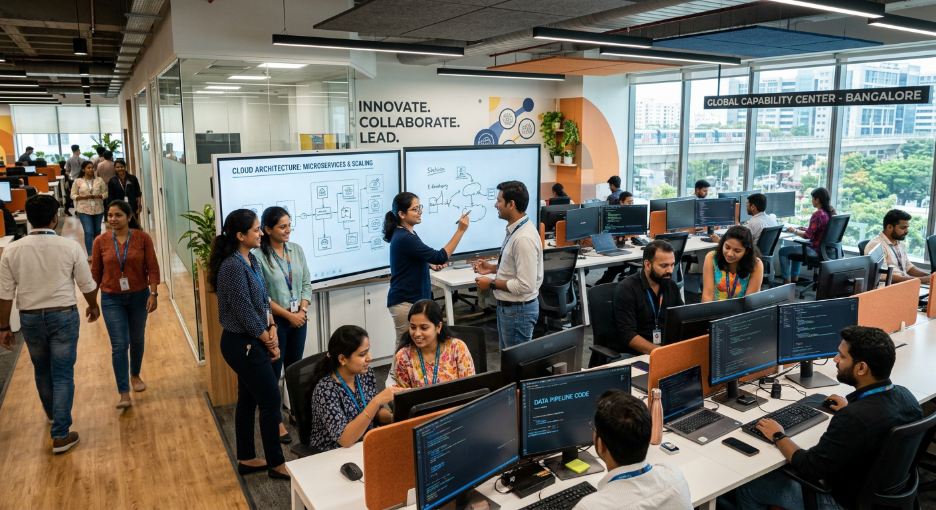
India’s GCC ecosystem is growing faster than anyone predicted. Across Bangalore, Hyderabad, Pune, Chennai, and Mumbai, global companies are building engineering centres at a pace that shows no signs of slowing. And every week, the same hiring challenge surfaces across GCCs at every stage of growth.
The roles stay open too long.
Not because the talent does not exist. It does. The problem is the gap between what GCC engineering roles actually require and what most staffing partners are built to find.
The keyword matching problem
Most staffing firms screen the same way. They take a job description, extract the technical keywords, and send 12 to 15 profiles that match the most terms.
For a Senior Full Stack Engineer JD listing React, Node.js, and AWS, this produces candidates who have used all three. What it does not produce is candidates who have worked in a cross-border pod structure, delivered at the pace a GCC operates at, or built systems at the complexity and scale your parent company expects.
The deeper issue is project context. An engineer who has contributed features to a product roadmap is fundamentally different from one who has owned a product end-to-end architecture decisions, release cadence, and business outcomes included. These distinctions are invisible to keyword matching. They only surface when someone who understands engineering asks the right questions.
By the time two or three keyword-matched candidates have failed the technical interview, three to four weeks have passed. The JD goes back to the vendor. The cycle repeats.
This is not a staffing industry failure. It is a structural mismatch. Most firms are built for volume hiring, not engineering depth.
Niche roles are a different problem entirely
Beyond standard engineering roles, GCCs building product and platform teams face a harder challenge. Some of the most complex skill combinations in the Indian market right now:
Palantir Foundry developers who combine ETL, PySpark, and Python with hands-on Foundry application development experience. This is a rare combination even globally.
Endur developers with working knowledge of JVS, AVS, and open components alongside SQL a niche that sits at the intersection of energy trading systems and enterprise software.
AI and ML engineers who have taken models from notebook to production feature stores, model versioning, drift monitoring, and retraining pipelines. Not data scientists who have completed certifications, but engineers who have built and maintained production ML infrastructure.
Snowflake administrators with real enterprise data warehouse governance experience. Azure data engineers who have designed and delivered at scale, not just completed cloud certifications.
Salesforce developers with complex multi-cloud implementation experience across Sales Cloud, Service Cloud, and custom integrations. SAP practitioners with specific module depth and implementation track records on enterprise program.
What these roles share: the talent pool is thin, the candidates are almost never actively looking, and job portal sourcing produces mismatches that waste everyone’s time. Finding the right person requires knowing exactly where to look and how to have the right conversation when you find them.
What the right GCC engineering staffing partner looks like
Four things separate a partner genuinely built for GCC engineering hiring from one that is not.
Engineering-led screening. Every profile that reaches your hiring manager should be technically assessed by a practicing engineer, not an HR screener. The difference between a Python developer who has written automation scripts and one who has built microservices on AWS Lambda at production scale does not show up in a CV. It shows up in a technical conversation with someone who has done the same work.
3 to 5 profiles per submission, not 15. If your partner sends 15 CVs, they are shifting your hiring manager’s filtering work onto your calendar. A partner who knows their business submits 3 to 5 assessed profiles every one of whom would pass your first technical round.
GCC operating model knowledge. The best candidates for a GCC role are often passive not actively looking, but open to the right conversation. Positioning a GCC opportunity compellingly to a passive candidate requires understanding what makes a GCC career move genuinely attractive. That understanding is not something you get from a client brief.
Accountability beyond the placement. A replacement guarantee 60 days for standard roles, 90 days for niche and certified roles is the minimum bar. No retainer. No exclusivity. You should be able to evaluate a partner on one mandate before committing to anything further.
The GCC insider advantage
There is one differentiator worth naming directly.
ZiniosEdge carries deep institutional knowledge in how GCCs are built, scaled, and run. Our leadership team has been involved in setting up some of India’s largest and most complex GCC programmes not as advisors observing from the outside, but as practitioners who have made the hiring decisions, built the talent architecture, and understood the pressure that a GCC Head feels when a critical engineering role has been open for 90 days.
That pedigree changes every step of a hiring engagement. From how a JD is decomposed before sourcing begins, to how a passive candidate is approached and positioned, to how an offer is managed through a long notice period. It is not something that can be learned from a client brief or replicated by a firm that has only ever operated as a staffing vendor.
What fast GCC engineering hiring looks like in practice
Day 1: A 30-minute JD intake call with the hiring manager not just reading the job description, but understanding the team context, the project nature, the technical depth required, and what a successful hire looks like at 6 months.
Day 3 to 5: First shortlist. 3 to 5 profiles, each with a written technical assessment summary that tells the hiring manager what to probe in the interview not just a CV with a cover note.
Week 2: First round interviews scheduled and managed.
Week 3 to 4: Offer stage. Candidate retention call within 24 hours of offer issuance. Notice period management begins.
Day 60 post-joining: Replacement guarantee in effect. No additional fee.
That process is repeatable across all open mandates simultaneously, whether your GCC is in Bangalore, Hyderabad, Pune, Chennai, or anywhere else across India.
The bottom line
GCC engineering hiring does not have to take 90 days. It takes 90 days when the wrong partner is sourcing the wrong way.
The right partner screens with engineers, assesses project context not just keywords, submits 3 to 5 qualified profiles, understands your GCC operating model, and stays accountable after joining day.
If your GCC has engineering roles that have been open longer than they should whether they are standard engineering roles or highly specialized platform or data roles the talent exists across India. The question is whether your current staffing partner is built to find it.
ZiniosEdge is a digital engineering company and Microsoft Certified Solutions Partner with offices across India. We provide engineering staffing, delivery pods, cloud infrastructure, AI/ML engineering, and application modernization for GCCs and enterprises. We are ISO 27001 and SOC2 Type I certified.
For GCC engineering hiring enquiries: sushil.kg@ziniosedge.com | +91 98861 16356 | www.ziniosedge.com
FAQs
1. Why does it generally take so long to hire GCC engineers?
Most of the GCC engineering positions are open for months at a time as the hiring process is too often keyword matching and not a real technical evaluation. Many candidates may look good on paper, but lack the product ownership, scale or cross-functional experience GCCs really need. Weeks are lost before they find those gaps through multiple rounds of interviews.
2. How is GCC engineering hiring different than regular tech hiring?
GCCs typically hire for more complex environments. Engineers are often expected to work with global teams, manage large scale systems and contribute beyond coding alone. That means hiring managers to look for problem-solving skills, product thinking, and experience in enterprise-grade engineering, not just technical keywords on a resume.
3. Why is it challenging to fill specialized engineering jobs in GCCs?
Roles involving platforms like Palantir Foundry, Endur, Snowflake, SAP, or production-grade AI/ML systems require highly specialized experience. The talent pool is limited, and most qualified candidates are not actively looking for opportunities. You need to find them, have technical conversations with them – don’t just apply to job portals.
4. How can GCCs reduce delays in engineering hiring?
In general, the fastest hiring results are achieved by working with staffing partners who understand engineering inside and out. Technical screening, smaller but better-qualified candidate shortlists, faster interview coordination and proactive notice period management can cut hiring timelines significantly.
5. What should GCCs look for in an engineering staffing partner?
A strong GCC staffing partner should understand both technology and the GCC operating model. They should provide technically assessed profiles, understand niche engineering requirements, and stay involved even after the candidate joins. Quality matters far more than sending a large number of resumes.