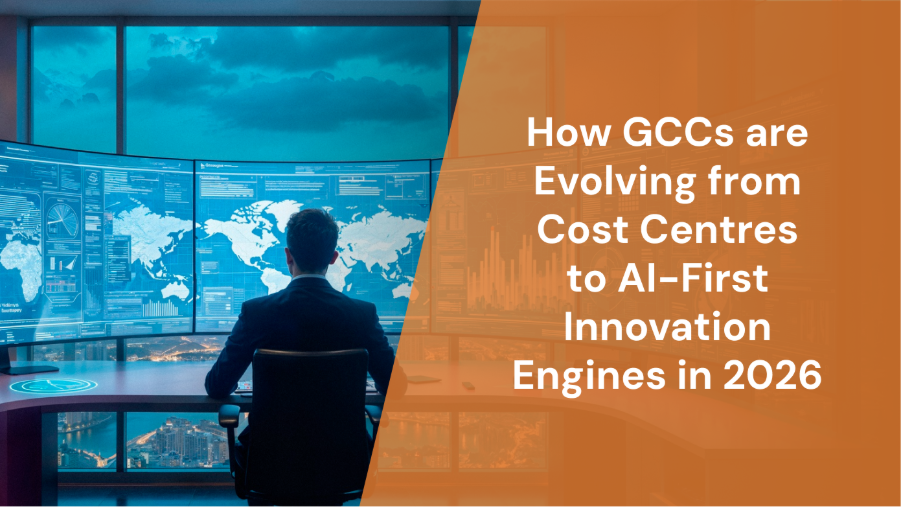
For most of the last two decades, the Global Capability Centre (GCC) model ran on a simple premise: move work to India, reduce costs, maintain quality. That logic helped enterprises scale efficiently. However, in 2026, it no longer explains how leading GCCs operate, or why global organizations are investing in them differently.
At ZiniosEdge, we have spent 12+ years at the centre of this shift working from Bengaluru with enterprises building and scaling GCCs that are now expected to deliver far more than cost efficiency.
India now represents over 50% of the global GCC footprint, and nearly 44% of these centres have evolved into “portfolio” or “transformation hubs” with end‑to‑end ownership of products, platforms, and global mandates. Enterprise expectations have shifted accordingly. Recent GCC leadership surveys show that a majority of India-based centres are now responsible for AI platforms, advanced analytics, cloud architecture, and enterprise-wide automation, not just execution or support.
Crucially, the real value of GCCs was never the arbitrage alone. It has always been India’s depth of digital talent, ability to scale AI and data capabilities, and capacity to build intellectual property at enterprise speed. Thus, innovation, and not cost, is now the primary growth driver.
How the Role of Global Capability Centers Has Evolved in India
Over time, GCCs matured into shared services and IT delivery hubs. Engineering teams expanded, processes standardized, and Indian centres began handling core software development and analytics for global enterprises. Progress, but still largely execution-led.
In 2026, the picture is structurally different. GCCs are now owning product engineering end to end, building AI platforms, and driving digital transformation roadmaps without waiting for direction from headquarters. The centre is no longer receiving requirements. In the most advanced cases, it is generating them. This shift reflects a fundamental change in how enterprises think about where capability should live and who should hold accountability for outcomes.
Why Cost Arbitrage Alone is No Longer a Competitive Advantage
Labour savings remain real, but they are no longer sufficient as a strategic rationale for GCC investment. The complexity of modern digital systems demands genuine technical ownership, not just execution capacity. Building cloud-native architectures, deploying machine learning at scale, and maintaining real-time data platforms require contextual judgment that a task-focused delivery model cannot provide.
The hidden costs of purely low-cost models are also better understood now. Rework cycles, coordination overhead, and attrition-driven knowledge loss erode the savings that look attractive on paper. The question is no longer how to reduce cost per headcount. It is how to accelerate time to market and build durable digital capabilities, and those outcomes require a different operating model entirely.
CTA: Rethink your GCC strategy for long-term innovation and business impact.
What Is Driving the Shift Toward Innovation-Led GCC Models
Several forces have converged to make this shift not just possible but necessary.
- AI and automation have changed what is achievable inside a GCC. Agentic systems that handle reasoning, process orchestration, and decision support make the old model of a centre as a human execution layer obsolete. GCCs embedding AI into core workflows are delivering faster, more consistent outputs than traditional delivery models ever allowed.
- India’s talent market has matured significantly. The depth of engineering, data science, product management, and architecture expertise now available supports roles that were once assumed to require physical presence at headquarters. GCCs can hire professionals capable of owning global product mandates outright.
- End-to-end ownership is becoming the norm. The most effective centres today hold full responsibility for platforms and products tied directly to enterprise revenue. That accountability structure changes how teams prioritize and how they measure their own success.
- Ecosystem maturity in cities like Bengaluru, Hyderabad, and Pune has reduced friction in scaling high-value capabilities. The infrastructure, policy environment, and talent pipeline now support ambition in ways they did not a decade ago.
How Indian GCCs are Becoming Global Innovation Engines
What was once aspirational is now operational. Centres are building proprietary AI systems, managing digital platforms, and delivering products that contribute directly to enterprise revenue and customer experience.
Leadership structures have shifted alongside the work. Global CIOs, CTOs, and product heads are increasingly based in India as genuine decision-makers with global mandates, not just regional proxies. R&D budgets once concentrated at headquarters are being allocated to India-based teams that have proven they can deploy them effectively. The strongest GCCs are now strategic peers, shaping roadmaps and influencing how the global enterprise competes.
What This Shift Means for Enterprise Operating Models
When a GCC moves from delivery execution to outcome ownership, the enterprise operating model has to move with it. Governance structures built for cost-centre oversight do not work when the centre is accountable for business results. Decision rights need to be redistributed, and GCC leaders need genuine authority to make meaningful choices, not just implement them.
Talent strategy must follow. Hiring for volume makes sense in a delivery operation, but not when the goal is building an AI capability or product engineering function that generates competitive advantage. The investment profile shifts from generalist breadth to specialist depth, and performance metrics must shift from seat count and SLA adherence to speed to market, customer impact, and innovation output.
CTA: Set up and scale a GCC with strong engineering, AI, and delivery foundations.
Key Challenges in Transitioning from Cost Centre to Innovation Hub
The transition is worth pursuing, but the obstacles are specific enough to warrant honest attention.
Legacy perceptions within leadership remain among the most persistent barriers. Reframing a GCC from a cost-reduction lever to an innovation engine requires more than a strategy presentation. It requires evidence, sustained relationship-building, and often a shift in who is making the decisions.
Capability gaps in product thinking, domain expertise, and solution architecture are real constraints. The pipeline is growing, but it does not yet move at the pace of enterprise demand. Organizations that expect the transition to happen quickly tend to underestimate the cultural and organizational work involved.
Without clear ownership models, innovation efforts remain fragmented. Good ideas surface, get partially resourced, and lose momentum when delivery pressure arrives. Clarity about who owns what is not glamorous work, but it is often the work that determines whether transformation actually happens.
How ZiniosEdge Helps Enterprises Build Innovation-Le
ZiniosEdge is a Bengaluru-based digital transformation partner with 12+ years of experience helping global enterprises design, launch, and scale GCCs in India. As a certified Microsoft Solutions Partner, AWS partner, and authorised licence reseller, ZiniosEdge gives GCC teams immediate access to specialists across AI/ML, Cloud, AR/VR, Product Engineering, Industrial IoT, and Microsoft enterprise platforms without the 3–6 month direct hiring cycle. ZiniosEdge delivers through two models purpose-built for GCC clients. The Engineering Pod embeds a pre-assembled team a Delivery Lead with 10+ years of experience, Senior Engineers matched to the client’s tech stack, QA, and DevOps directly into the GCC’s delivery workflow from Week 1. The Build-Operate-Transfer (BOT) model takes enterprises from GCC setup through to full operational independence, with ZiniosEdge managing delivery accountability and transferring full team ownership within 12 to 24 months. Most engagements begin with a focused 60-day pilot one pod, one workstream, measurable outcomes before any long-term commitment. For enterprises evaluating how to evolve their GCC from cost-centre to innovation engine, that pilot is typically where the answer becomes visible.
CTA: Embed AI into your GCC workflows to unlock faster decisions and measurable business impact.
Key Takeaways for Leaders Evaluating GCC Strategy in 2026
The GCC model has moved on from its cost-reduction origins. Strategic capability creation is now the measure of success, and that requires a different investment mindset, governance approach, and definition of what the centre is for.
India’s ecosystem supports the full range of capabilities needed for end-to-end innovation. The talent, infrastructure, and track record are all in place. The question is whether enterprise leadership is prepared to extend the mandate that allows GCCs to use those capabilities fully.
Organizations that hold onto the cost-centre framing risk underutilizing one of their most significant strategic assets. The centres treated as genuine partners become genuine partners. The ones managed as delivery vendors tend to stay exactly that.
The future of GCCs is built on ownership, accountability, and measurable business impact. For leadership teams still evaluating where they stand, the time to act is now.
ZiniosEdge partners with enterprises to design, build, and scale GCCs with strong engineering, AI, and data foundations. To explore what an innovation-led GCC could look like for your organization, visit ziniosedge.com.